 Cases:Der Nominativ
The nominative case is used to describe the subject of a sentence. The subject is the main actor in the sentence, the person who carries out an action:

| Die sieben Zwerge wohnen in der Dachetage. | The seven dwarves live in the loft apartment. |
| Ihre Wohung ist hell und groß. Aber manchmal vermissen die Zwerge ihr altes, romantisches Haus aus dem 19. Jahrhundert. | Their apartment is bright and big. But the dwarves sometimes miss their old, romantic house from the 19th century. |
| Dort haben die Zwerge ihre geliebte Prinzessin, Schneewittchen, kennen gelernt. | It was there that the dwarves met their beloved princess, Snow White. |
The nominative case is also used to describe predicate nouns (i.e., nouns that are on the other side of verbs such as sein, bleiben, heißen, werden, scheinen from the main subject):
| Die Prinzessin ist und bleibt die schönste Frau, die die Zwerge sich vorstellen können. | The princess is and remains the most beautiful woman that the dwarves can imagine. |
| Sie ist auch sehr intelligent; Schneewittchen wird Rechtsanwältin. | She is also very intelligent; Snow White is is going to be (i.e., training to be) a lawyer. |
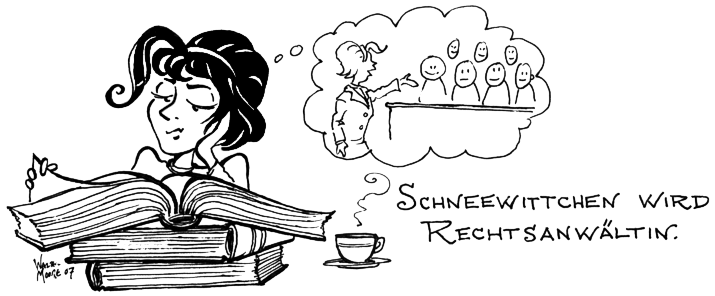
In the first example, die Prinzessin is the main subject and die schönste Frau is the predicate noun. In the second example, Schneewittchen is the main subject and Rechtsanwältin is the predicate noun.
The biggest trick to being able to use the nominative case (and all four cases, really) is to know the gender of nouns. If you don't know whether Zwerg is masculine, feminine, neuter or plural, the cases can't really fall into place.
 Definite and indefinite articles in the nominative case
Articles in the nominative case (there is no equivalent of the indefinite article in the plural, since, just like in English, you can't say "a dwarves"):
| the | a/an | english | |
| masculine | der Prinz | ein Prinz | (prince) |
| feminine | die Prinzessin | eine Prinzessin | (princess) |
| neuter | das junge Paar | ein junges Paar | (young couple) |
| plural | die Zwerge | Zwerge | (dwarves) |
Following are the personal pronouns, which can replace nouns (and only exist in pronoun form for the referents: I and you), in the nominative case:
| ich | I |  |
sie | she | |
ihr | you |
| du | you | es | it | sie | they | ||
| er | he | wir | we | Sie | you (formal) |

Übung 1
Who is doing what in the castle? Select the subject of each sentence from multiple choice options.
| 1. | Die schöne Königin lebte in einem Schloss und nähte (sewed).
|
||
| 2. | Ihr ganzes Leben wollte die Königin ein Kind.
|
||
| 3. | Ihre kleine Tochter ist wunderschön.
|
||
| 4. | Leider stirbt die Königin sobald (as soon as) ihre Tochter geboren ist.
|
||
| 5. | Schneewittchens Vater heiratete ein Jahr später eine neue Königin.
|
||
| 6. | An der Wand der neuen Königin hängt ein Spiegel (mirror).
|
||
| 7. | Die Königin fragt den Spiegel fast jeden Tag: Wer ist die Schönste im ganzen Land?
|
||
| 8. | Als Schneewittchen 7 Jahre alt wird, ist sie schön wie der klare Tag und schöner als die Königin.
|
||
| 9. | Die Königin hasst das Mädchen und sagt dem Jäger, dass er Schneewittchen umbringen (kill) soll.
|
||
| 10. | Bald gehen Schneewittchen und der Jäger in den Wald, aber der Jäger kann Schneewittchen nicht töten.
|
Übung 2
As you know, the story didn't end here. Find out what happened in the Grimm Brothers' version by filling in the following sentences with correct subjects from the word bank.
| Word bank | ||||
| die böse Königin | es | das junge Paar | die sieben Zwerge | ein junger Prinz |
| Der erste Zwerg | der siebte Zwerg | Sie | Das kleine Mädchen | ein kleiner Tisch |
| 1. | __________ läuft weg in den großen, dunklen Wald. |
| 2. | Einige Stunden später findet __________ ein kleines Haus in der Mitte des Waldes. |
| 3. | In dem Häuschen steht __________ mit sieben Tellerchen (plates), mit sieben Löffelchen (little spoons) und sieben Messerchen (little knives). |
| 4. | Als es ganz dunkel wird, kommen __________ von der Arbeit (from work) nach Hause. |
| 5. | __________ sagt: Wer hat auf meinem Stühlchen gesessen? (who sat on my chair?) |
| 6. | In ihrem Schlafzimmer findet __________ das kleine, wunderschöne Kind, das nachher (afterwards) bei den Zwergen lebt (who lives with the dwarves). |
| 7. | Eines Tages fragt __________ ihren Spiegel; Wer ist die Schönste im ganzen Land? |
| 8. | __________ versucht, Schneewittchen zu töten: zuerst mit einem Schnürriemen (lace for her dress), mit einem giftigen Kamm (poisoned comb) und mit einem giftigem Apfel (poisoned apple). |
| 9. | Die Zwerge sind traurig als Schneewittchen stirbt, aber Gott sei Dank kommt __________ und rettet Schneewittchen. |
| 10. | __________ heiratet (marries) und lädt auch die Stiefmutter zur Hochzeit ein (invites the stepmother to the wedding too). |